
 Subscriptions

Read our Monthly Magazine
And support our mission to provide fearless stories about and outside the media system
Reform UK delegates dismissed the climate crisis as a “farce” and accused scientists of manipulating evidence at the party’s annual conference, days after the Met Office provisionally declared the UK’s hottest summer on record.
Despite having its press passes revoked at the last minute, Byline Times spoke to delegates as they queued to enter the conference hall last weekend. They were happy to share their views, with some describing climate change as a means of Government control.
The interviews suggest that the rejection of climate science by Reform UK leader Nigel Farage and Deputy Leader Richard Tice finds a receptive audience among sections of the party’s membership.
Reform UK opposes net zero – the goal of balancing greenhouse gas emissions with their removal from the atmosphere. An analysis published by DeSmog in April found that the party had received more than £24 million from donors with financial interests in fossil fuels since its launch as the Brexit Party in 2019.
Watch: Reform UK Delegates Dismiss Climate Change
Jared Iverson, a Reform UK party conference delegate, described himself as a journalist and climate change denier. He told Byline Times outside the conference hall that the Government was lying to the public about climate change, as he claimed it had about COVID-19. He expressed a “deep distrust of the Government” and accused climate scientists of “following the money”, an allegation unsupported by evidence.
“What climate crisis?” said a smartly dressed couple in their late 60s, sporting a Union Jack jacket and bow tie. They claimed scientists had “cherry-picked the data” to support their theories.
The couple accepted that the climate had changed over time but insisted the world was heading towards a cooling period rather than “some catastrophic warming”.
“What we are talking about is controlling mankind,” they said. “We are passionate about that.”
A farmer based in Devon, dressed in tweed, was equally dismissive, calling the climate crisis “a farce”.
“I’ve lived and grown up in the countryside all my life,” he said. “They all talk about the temperatures moving and that, but I think we are colder now than when I was a kid.”
Asked how he knew it had been “definitely” a lot warmer during his childhood, he told Byline Times: “Because I spent my life in shorts.”
ENJOYING THIS ARTICLE? HELP US TO PRODUCE MORE
Receive the monthly Byline Times newspaper and help to support fearless, independent journalism that breaks stories, shapes the agenda and holds power to account.
We’re not funded by a billionaire oligarch or an offshore hedge-fund. We rely on our readers to fund our journalism. If you like what we do, please subscribe.
The temperature records tell a different story. The Met Office has announced that this summer was provisionally the UK’s hottest on record, with temperatures reaching 38.1°C at Kew Gardens in London. Wildfires also engulfed homes in Stourbridge.
Dr Amy Doherty, who leads the Met Office’s National Climate Information Centre, said: “The conditions we’ve seen this summer have broken UK climate records once again. These records are now breaking with increasing frequency, reflecting the influence of human-induced climate change on the temperatures we’re experiencing in the UK.
Particularly notable is how much we’ve exceeded the previous summer mean temperature record, set just last year. The figures also knock the infamous summer of 1976 down to seventh for average summer mean temperature, with the top five warmest summers all occurring since 2003.
A common refrain among those interviewed was that they had done their own research.
“There is no climate change. It’s absolute nonsense,” one delegate told Byline Times. “What you have got to do is do some of your own research, and you will find out that it is cyclical.”
“I looked into it,” the delegate added. “I’ve spent 10 years and I can’t find a single scientist who agrees with any climate change.”
Another delegate in a Union Jack jacket treated the question as a matter of personal choice: “Pick a camp, believe what you want. Do your own research. You decide.”
A less common explanation came from a delegate carrying a Moses-style staff, who said climate change was the will of God. “God can change the climate any second he wants, because he is the creator,” he said.
The scientific consensus on human-made climate change is overwhelming. A 2021 study, drawing on a dataset of 88,125 climate-related papers, concluded that more than 99% of the scientific literature supported human-caused climate change.
Responding to similar claims on a television panel show more than a decade ago, world-renowned physicist Professor Brian Cox said: “The absolute, absolute consensus is that human action is leading to an increase in average temperatures.”
Warnings about climate-driven migration met a similar response in the conference queue. A mixed group of five men waiting patiently said immigration was a top priority for Reform UK. Asked about the prospect of mass migration from places made uninhabitable by climate change, they shook their heads.
“That’s not going to happen,” they said.
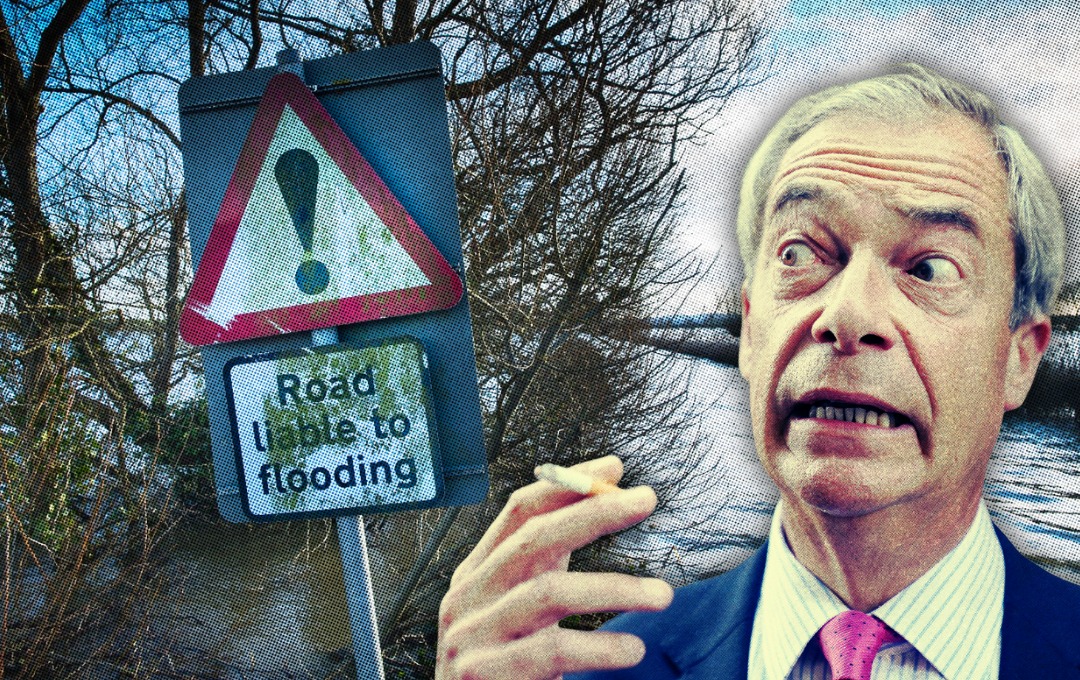
Drowning in Denial: One in Five Homes in Reform UK Heartlands Could Be Under Water Within 25 Years
As Nigel Farage’s party scraps climate schemes around the country, new data shows flood risk surging across the ten councils it leads
The UN’s International Organisation for Migration has cited estimates ranging from 25 million to one billion environmental migrants by 2050.
A 2018 World Bank report estimated that climate change could force as many as 143 million people in sub-Saharan Africa, South Asia and Latin America to move within their own countries by 2050. It identified water shortages, declining crop productivity, rising sea levels and storm surges among the pressures driving people from their homes.
That projection concerned large-scale internal displacement, but nevertheless highlighted the scale of disruption that the delegates dismissed.
The risks to Britain itself were addressed by Professor Tim Lenton, Chair in Climate Change and Earth System Science at the University of Exeter and founding director of its Global Systems Institute, at the National Emergency Briefing in Westminster last November.
Speaking to an audience of politicians, business leaders, leading scientists, academics, environmental organisers and representatives from culture, faith, sport and the media, Professor Lenton described the consequences if the current trajectory towards three or four degrees of warming later this century continued.
“Then we’ll definitely be in a national emergency because we’ll be at a high level of likelihood of crossing a tipping point in the climate,” he warned. “That will make this country a very different place, and a less habitable place to be.”