
 Subscriptions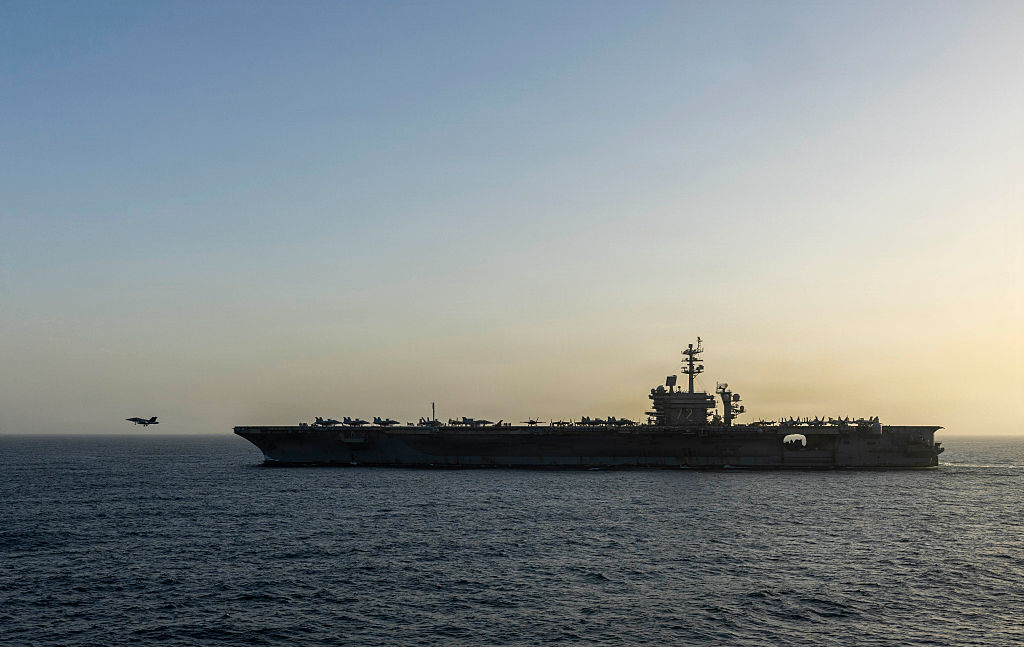

Read our Monthly Magazine
And support our mission to provide fearless stories about and outside the media system
The USS Abraham Lincoln (CVN-72) has been making headlines for all the wrong reasons. After over 260 days without a port visit, and 6 months on station off the coast of Iran, there are reports that sailors are dealing with inoperative toilets, washing machines, and showers. The “heads” (bathrooms) are covered in mildew and black mold. The food is disgusting and portion sizes suggest a starvation diet. The Lincoln and the USS Boxer have also supposedly run out of hygiene products like soap, toothpaste, shampoo, and menstrual products. Conditions are so bad that sailors have attempted suicide by throwing themselves off the ship: the 60-foot fall from the flight deck to the water has the potential to cause serious injuries.
The response of the Pentagon was to deny only the most outlandish claims, but not the ones published in the Navy Times and Stars and Stripes. President Trump when asked whether the Lincoln had been left on station for too long, responded in his inimitable way that the there were no problems, and that the deployment wasn’t “nearly long enough.”
There have been people on social media criticising these sailors for being “soft” or weak, but from a historical perspective what they are being subjected to is unprecedented: this is six straight months of combat operations without a port visit, while at the far end of a stretched logistics pipeline.
During the Vietnam War, individual continuous stints “on the line” at Yankee Station typically lasted around 30 to 35 days before a carrier headed to a port like Subic Bay in the Philippines for maintenance and rest. However, individual milestones were pushed further— for instance, the USS Ranger (CVA-61) set a notable historical benchmark when it spent a then-record 59 continuous days on Yankee Station in March 1965.
Prior to the USS Abraham Lincoln‘s modern record-breaking stretch, the longest consecutive period a US aircraft carrier had gone without a port visit was 206 days, set by the USS Dwight D. Eisenhower (CVN-69) in 2020 due to the COVID-19 pandemic. However, these were not combat operations. Which leads to the second part of the problem for sailors on a carrier in combat operations: which is crew rest.
The US Navy surface and submarine fleet has long had a problem with working people beyond the point of exhaustion. During an Operational Reactor Safeguard Exam (ORSE) on board the USS Augusta in 1995, I was working 36 on, 6 off, on 6-hour shifts for two weeks because I wasn’t allowed to sleep during the “day” when drills were going on, and that meant that I only got to sleep every other night effectively. At the end of that time frame, I was a hollow-eyed zombie that routinely fell asleep standing up.
The Navy determined that fatigue was a major cause in the collisions at sea of the USS John S. McCain and USS Fitzgerald in two separate incidents in the 2010s. These mishaps occurred after only a few weeks’ worth of time at sea and the accumulated fatigue. The crew of the USS Abraham Lincoln has been working 18-hour shifts for at least 6 months, if not longer. The fact that combat operations, general quarters, drills, threats of Iranian attack, and other disruptors mean that even this brutal schedule is likely being routinely disrupted. I cannot even begin to imagine the level of tiredness these people are facing, and neither can you: no one has ever had a deployment like this before.
Fatigue is not just a symptom of depression; severe physical and mental exhaustion can actively drive depressive states and increase suicide risk. Chronic exhaustion impairs brain function, lowers coping capacity, and makes life feel unmanageable, which deeply amplifies feelings of hopelessness and suicidal ideation. The conditions on the ship only make it worse.
Ships haven’t been meant to spend 9 months away from port, even in the age of sail. When I deployed to the Gulf on board the USS Arthur W. Radford in 2000, poor scheduling left us without a port visit or Underway Replenishment (UNREP) for 21 days. The Lincoln is also reportedly on a 21-day menu rotation. By the end the food was rice, beans, and freezer-burned beef sukiyaki that tasted like the chemicals they cleaned the freezer with. We tolerated it for a few days. The Lincoln’s crewhas been enduring it for months. Even if the allegations of the crew subsisting on 500 calories a day are not true, the pictures show the crew eating food that looks exactly like what we were eating in 2000 when we were scraping the bottom of the barrel.
In days past, carriers on-station in the Middle East could pull into port at Jebel Ali or Dubai. Not so now. The nearest available ports are either in the Red Sea, or Diego Garcia about 2,500 km away. UNREP requires supply ships, which are perilously high demand / low density assets after decades of the US neglecting the Military Sealift Command.
UNREP typically doesn’t bring random parts (except perhaps for aircraft) to fix dryers, heads, etc. If something breaks, and the part isn’t in inventory, it’s likely to stay broken unless you can convince someone to fly it out via Carrier On Board Delivery (COD), which just got a lot more difficult after the US Navy retired the last of the C-2 Greyhound aircraft and replaced it with the CMV-22B Osprey tilt-rotor aircraft, which spent much of 2025 grounded for safety reasons. Over time, the broken washers, dryers, heads, showers, etc add up.
Another part of the problem is that since the end of the first Gulf War, the US has slowly drawn down from 15 aircraft carriers to 11. The earth is the same size, but the number of carriers trying to cover it has gotten smaller. This means that when a carrier is needed out of cycle, they’re going to spend more time deployed. The US hasn’t fought a sustained war like this since Vietnam, and the 11-carrier fleet is proving to be unsustainable and insufficient. The ships are breaking almost as fast as the people manning them.
The US is replacing the Lincoln on station with the USS George Washington (CVN-73). However, this comes with a cost: the USS Washington was the last US carrier left in the Western Pacific. This comes as China has been significantly increasing its military activity around Taiwan. Combined with a reported shortage of missiles, the US Navy has not looked so weak in the Pacific since its nadir during the period between World War I and World War II.
Trump, just like dictators, seems to blame the collapse of morale on the sailors who have been pushed to the breaking point. However, the world is watching, and seeing the endurance, logistics, and capabilities of the US Navy have definite limits, and the Trump administration just drew them into sharp relief via a war of choice with Iran that it cannot negotiate its way out of.