

Read Our Monthly Magazine
And support our mission to provide fearless stories about and outside the media system
Senator Mark Warner walked out of a Gang of Eight intelligence briefing on Monday and told reporters that the stated objectives of the Iran War had shifted, by his count, four or five times in four days. Nuclear capacity. Ballistic missiles. Regime change. Something unspecified. He did not sound confused. He sounded like a man watching a technique he recognised and had no tool to stop.
That technique has a history.
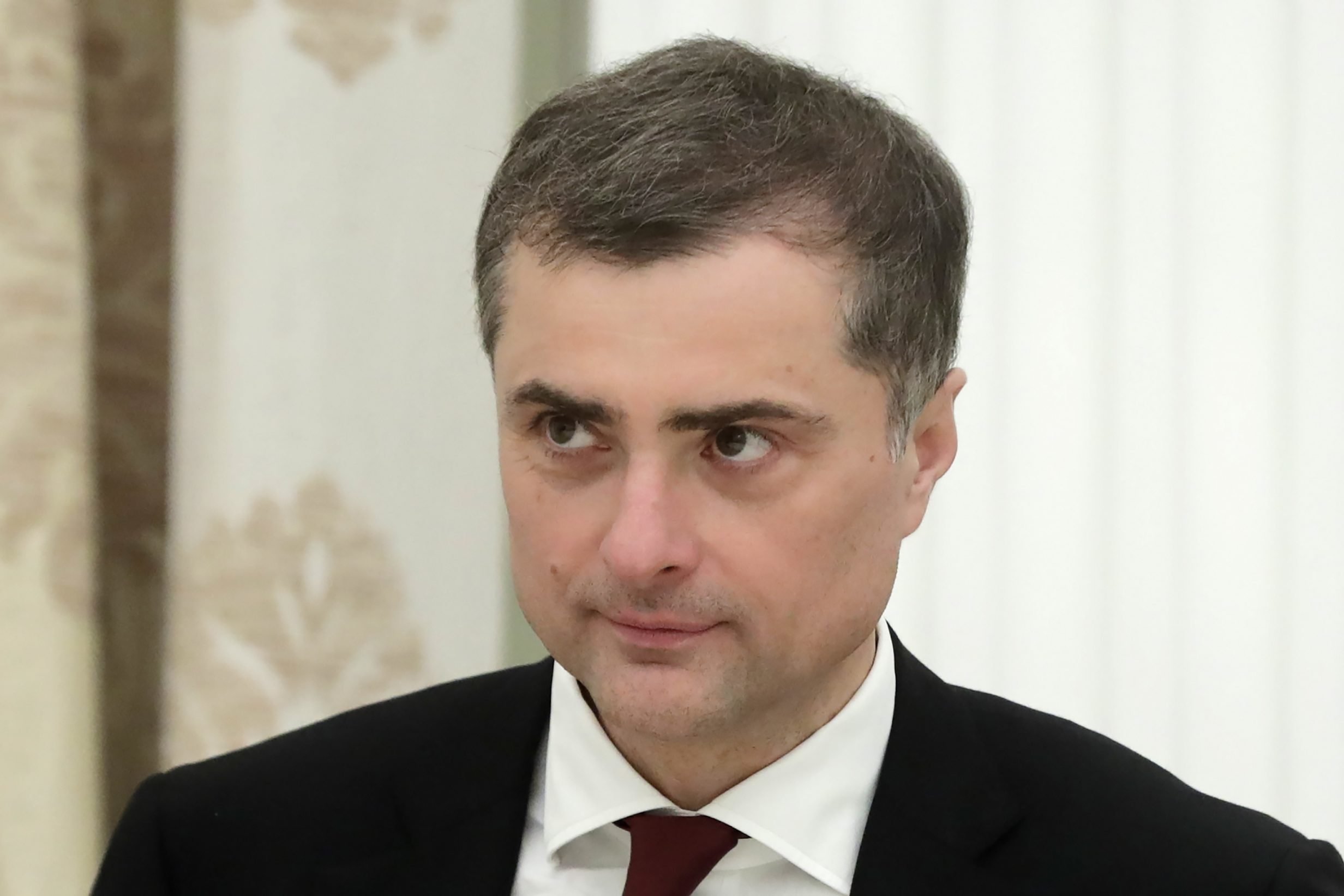
Vladislav Surkov, the Russian political strategist who shaped Putin’s information environment for two decades, held a conviction that most Western analysts spent years dismissing.
Surkov had no particular interest in winning arguments. His interest lay in dissolving the conditions under which arguments could be won or lost. He saturated spaces with competing frames, provisional justifications, and simultaneous contradictory positions until his opposition lost its footing. His achievements were structural. Remove the coherent object, and accountability collapses around it. You cannot challenge a position that has already moved. You cannot build a counter-movement against a justification that expires before you print the placards.
Four or five shifts in a four-day-old war. Each one landing before the previous had faced serious scrutiny. The mechanism Surkov refined deserves examination now, because it no longer arrives from outside the Western alliance.
It runs from within it.
Russian Interference is a Threat within the Brain
The Russia Report failed to grasp the philosophical underpinning of Vladimir Putin’s plans for the West, argues Zarina Zabrisky
Targeting Successors
The Khamenei succession crisis tells you what the press conferences won’t.
Israel claims its forces killed thirty senior Iranian officials within the first thirty seconds of the opening strike. Trump told Fox News that forty-eight Iranian leaders fell in the first two days. The strikes, which the operation’s own commanders described as both heavy and pinpoint, hit their targets across Tehran, Isfahan, Qom, Karaj, and Kermanshah with precision.
Iran’s leadership keep dying before anyone can speak with them. Khamenei fell in the first hours. Senior IRGC commanders followed across the days after. The leadership council that would carry a transition toward negotiation now scrambles inside an active military campaign. There are no numbers to call.
Trump acknowledged this himself, without apparent discomfort, in a call relayed by ABC News chief Washington correspondent Jonathan Karl. The administration had identified candidates within the Iranian Government to lead after Khamenei. “The attack was so successful it knocked out most of the candidates,” Trump told Karl.
In remarks to reporters on Tuesday, he added: “Most of the people we had in mind are dead. We had some in mind from that group that is dead. And now we have another group. They may be dead also based on reports. Pretty soon, we’re not gonna know anybody.”
A military campaign that wanted negotiation would leave someone to negotiate with. A campaign that wanted transition would leave the transition infrastructure intact. The Assembly of Experts, the eighty-eight-member clerical body that selects the supreme leader, convened inside a country under active bombardment. Israel then struck the building where it met. The succession crisis did not develop despite the precision of the strikes. The precision produced it.

The Decades-Long US-Israeli Plan for Regime Change in Iran Is Taking Shape
The recent attacks on Tehran are part of a long-standing plan by the US and Israel, argues Mel Frykberg
The Iraq Comparison
Senator Warner drew the Iraq comparison, and he had every right. The intelligence that turned out to justify a conclusion already reached; the weapons that never materialised; the war whose objectives kept mutating after the invasion because the original objective could not survive examination. Warner named the parallel accurately. What he left unsaid was why the structure is repeating.
The nuclear weapon Iran has not yet built functions as a particular kind of object in this operation: the impossible threat, always just over the horizon, that justifies everything in the present tense and resists resolution permanently.
You cannot negotiate away a capability that has not yet come into existence. You cannot declare victory over a weapon that nobody has yet made. The object stays live precisely because nothing can close it. The game, as designed, carries no endpoint.
Benjamin Netanyahu said it himself, on Fox News, without embarrassment. It falls to the people of Iran, in the final count, to change their government. This came from a man who spent years watching Iranian proxies dismantle what he had built, who carries October 7th as a failure of protection that no military success will fully answer, and who found in Washington a partner prepared to hand him the most powerful military on earth as an instrument of response.
Whether Washington grasped the logic it was lending itself to, historians will contest. The result presents itself clearly enough: a war with a brand name – Operation Epic Fury, objectives that shift every forty-eight hours, a succession architecture targeted alongside the leadership that inhabited it, and a President who names his preferred successors as he reports them dead.