

Forget ‘peak oil’. Nafeez Ahmed reveals how the oil and gas industries are cannibalising themselves as the costs of fossil fuel extraction mount
A team of French government energy scientists are warning that the collapse of the global oil system is coming so rapidly it could derail the transition to a renewable energy system if it doesn’t happen fast enough. In just 13 years, global oil production could enter into a terminal and exponential decline, accompanied by the overall collapse of the global oil and gas industries over the next three decades.
But this is not because the earth is running out of oil and gas. Rather, it’s because they are increasingly eating themselves to stay alive. The oil and gas industries are consuming exponentially more and more energy just to keep extracting oil and gas. That’s why they’ve entered a downwards spiral of increasing costs of production, diminishing profits, rising debt and irreversible economic decline.
Hanging on for dear life to the old, dying fossil fuel paradigm is a recipe for civilisational suicide.
The implication is that global energy shortages and price spikes will be a taste of things to come if we stay dependent on fossil fuels. Yet a growing narrative has instead wrongly pinpointed the ‘clean energy transition’ as the culprit.
The Economist, for instance, describes the global gas price spikes as “the first big energy shock of the green era”, blaming inadequate investment in renewables and “some transition fossil fuels” (like gas). This could lead to “a popular revolt against climate policies.”
This implies that the fundamental driver of global energy volatility is the transition away from fossil fuels: but this flawed narrative has it exactly backwards.
Energy Return On Investment (EROI)
The key to understanding all this is in how the new study, published in Elsevier’s Applied Energy journal, applies the concept of ‘Energy Return On Investment’ (EROI).
Pioneered by systems ecologist Professor Charles Hall (whom I worked with on my book Failing States, Collapsing Systems) EROI measures how much energy you must use to extract energy for a given resource or technology. The metric works as a simple ratio that estimates the quantity of energy you can get out for every single unit of energy that’s put in. So obviously, the higher the ratio the better, because it means you can get more bang for your buck.
The new study is authored by three French government scientists – Louis Delannoy, Pierre-Yves Longaretti and Emmanuel Prados of the National Institute for Research in Digital Science and Technology (INRIA) which operates under France’s Ministry of National Education and the Ministry of Economy, Finance and Industry – along with David J. Murphy, an environmental scientist and energy expert at St. Lawrence University in New York.
Their research found that 15.5% – more than a tenth – of the energy produced from oil worldwide is already necessary to keep producing all the oil.
Yet this is getting worse, not better. Since the production of the easiest-to-get conventional oil slowed down and plateaued around fifteen years ago, we’re increasingly relying on forms of difficult-to-extract unconventional oil that uses greater amounts of energy for more complex techniques like fracking.
The Downwards Spiral
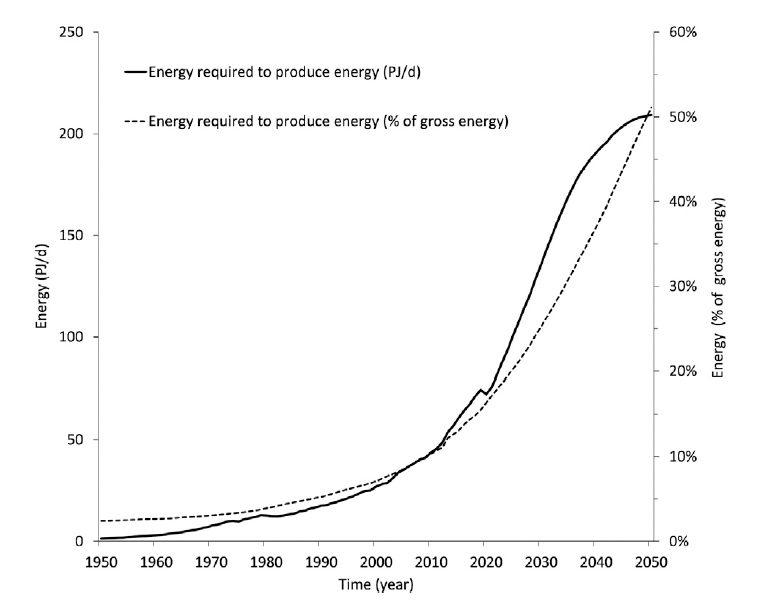
In 1950, the EROI of global oil production was really high, at about 44:1 (meaning, for every unit of energy we put in, we were getting a whopping 44 out). Yet as the graph below from the new study illustrates, this value has undergone a shockingly steep decline.
By 2020, it reached around 8:1, and is projected to decline and plateau to around 6.7 from 2040 onwards.

By 2024 – within the next four years – the amount of energy we are using for global oil production is going to increase to 25% of energy production. In other words, the world will be using a quarter of the energy produced from oil just to keep producing that oil.
But instead of getting more efficient, fossil fuel technologies are getting less efficient – which is why the quantity of energy we need to keep producing oil is exponentially increasing.
By 2050, fully half of the energy extracted from global oil reserves will need to be put back into new extraction to keep producing oil. The authors have an interesting name for this self-defeating phenomenon: they call it, “energy cannibalism.”
This tendency is having massive consequences on long-term economic growth that few mainstream economists acknowledge today. The key issue is that the more energy we need to extract energy itself, the less energy is available for other areas of the economy and society.
As economists Professor Tim Jackson and Dr Andrew Jackson of the University of Surrey have shown, there is now abundant scientific evidence that the decline in EROI is an underlying driver of the decline in economic growth.
This suggests that the last two decades of global economic turbulence are closely related to the global economy’s continued structural dependence on fossil fuels: a dependence that, if it goes on, will guarantee a grim future of energy and economic decline amidst mounting environmental crisis.
Yes, the Age of Fossil Fuels is Ending
What does this mean for the idea of ‘peak oil’?
Previous discussions about peak oil, the scientists say, were too polarised to be helpful. So they call for a re-opening of the deb