


Read Our Monthly Magazine
And support our mission to provide fearless stories about and outside the media system
The role of Sergey Nalobin, the senior ‘diplomat’ at the centre of my story about Russian political interference in the run up to the EU Referendum, was among the key evidence that clinched the successful criminal prosecution in a Russian interference case by Estonian law enforcement.
The British authorities repeatedly refused to investigate Russian interference in the Brexit campaign and the UK’s broader politics. However, court proceedings have revealed that Nalobin, who was looking for a way to channel money into the Conservative Party in the early 2010s, had also been at the centre of a political interference campaign in Estonia. Moreover, he was identified as an intelligence officer by Ukrainian and Estonian sources.
Oleg Bessedin, arguably the country’s most influential Russian propagandist, was sentenced to seven years in prison for non-violent activities against Estonia and breaches of international sanctions. Perhaps the most infamous propagandist that comes to mind in the British historical context is William Joyce (“Lord Haw-Haw”), who broadcast Nazi propaganda from Germany to UK audiences during the Second World War.
According to Delfi, an Estonian investigative news outlet, Bessedin operated Estonia’s most influential Russian-language propaganda platform, supported by individuals linked to Russia’s Foreign Intelligence Service (SVR) and Federal Security Service (FSB). Disinformation is a key element of Russian political interference operations, alongside covert political finance and cyber.
In line with established practice, Russian intelligence did not pay Bessedin directly. Given that he did not have access to classified information, there was no need for a designated handler, either. Instead, the Russians helped Bessedin with setting up a large distribution for his YouTube channel.
For example, in 2024, his two interviews pushing a well-timed Kremlin narrative about the apparent superiority of the Russian Oreshnik ballistic missile clocked 2.8 million and 2.4 million views respectively on the platform. The Civic Resilience Initiative with support from Google found that 34 of the 50 most-engaged Kremlin-aligned posts it monitored in Estonia came from Bessedin’s YouTube channel. The set up paid off: YouTube provided him with a monthly income of EUR 5,000 – 7,000. He supplemented that with secretly selling the rights to two of his documentaries to RT, a Russian government propaganda broadcaster sanctioned on both sides of the Atlantic. About €77,000 of Bessedin’s criminal proceeds were confiscated in the end. The police also seized large amounts in Russian roubles at his home, the origin of which was unexplained.
Saying the ‘Unsayable’: Russian Interference
Andy Burnham has broken a decade of establishment silence over Putin’s plan to get Britain out of the EU. Peter Jukes reports
The London Trail
What is interesting from the British perspective is that the Estonians gave particular weight in the evidence to the fact that Bessedin was supported in his activities by none other than Sergey Nalobin, the same Russian diplomat who was at the heart of Russian political interference operations in London when David Cameron was at No 10.
Chief Public Prosecutor Taavi Pern told the court how Nalobin secured high-profile and very hard-to-get interviewees for his programmes. There was extensive correspondence between the two, with Bessedin asking Nalobin for guidance in his activities, for contacts and even personal favours, such as helping to obtain a place for his wife’s daughter at a university in Russia. It was also Nalobin who facilitated “technical” help from ANO Dialog, an organisation which was linked to Russia’s Doppelganger (Twin) disinformation operation by the US authorities. Reporting to the Russian Presidential Administration, Dialog is at the heart of Putin’s propaganda and political interference effort and is sanctioned by the European Union.
I have followed Sergey Nalobin’s career closely ever since he first approached me at the end of 2010 and told me that he knew Russian companies willing to contribute to the Conservative Party. At the time, I was a high-flying fundraiser for the Party. He had been appointed First Secretary (Political) at the Russian Embassy in London only a few months earlier.
I realised that what he proposed constituted not only a criminal offence under UK law, but an attempt to corrupt British politics by a hostile state. It was a threat to national security, so I alerted MI5. To my amazement, I was told that there was “no evidence that [Nalobin] is anything but [a] genuine [diplomat]”. So, nothing was done, and a year later he was behind the launch of Conservative Friends of Russia, another Russian political influence initiative, which lasted only a few months before it imploded amid a very public scandal.
Nalobin was eventually pushed gently out of the UK by the Foreign Office in 2015 and, as fate had it, arrived in Tallinn four years later as second in command at the Russian Embassy there. In contrast to their British counterparts, the Estonians did not mess about and expelled Nalobin for actively undermining the security of the country. Ukrainian sources close to their country’s security services then confirmed that Nalobin was in fact a Russian intelligence officer.
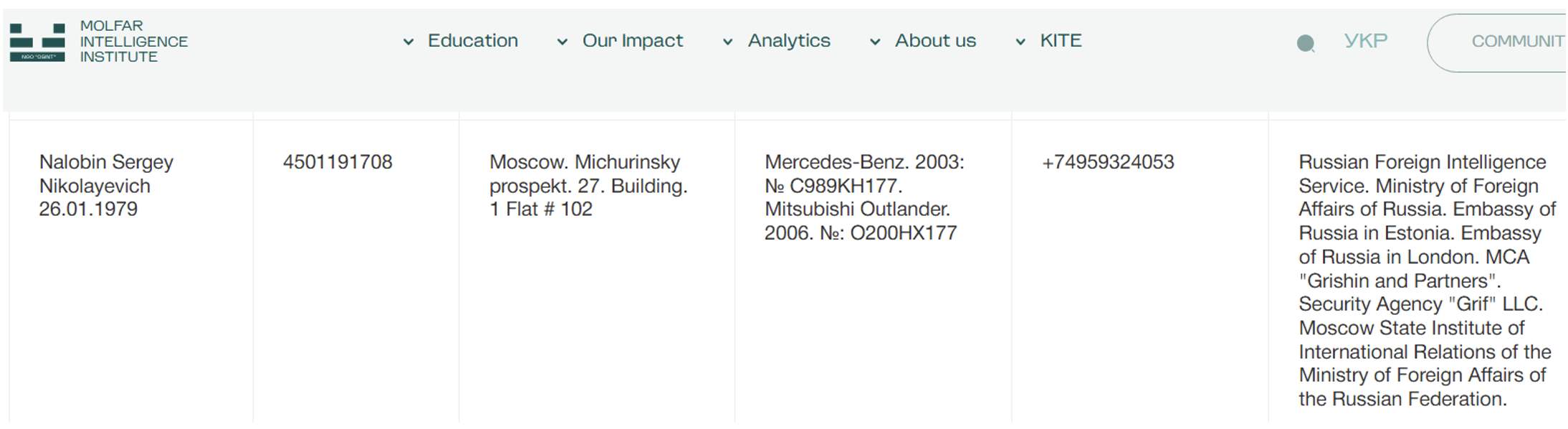
This was also collaborated by a former head of Estonia’s intelligence service during his interview with Sergei and Westminster Spy Ring an award-winning podcast in which Carole Cadwalladr and Peter Jukes helped me to get this story into the open. More recently, Nalobin was linked to the arson attack on the properties of Prime Minister Keir Starmer.
ENJOYING THIS ARTICLE? HELP US TO PRODUCE MORE
Receive the monthly Byline Times newspaper and help to support fearless, independent journalism that breaks stories, shapes the agenda and holds power to account.
We’re not funded by a billionaire oligarch or an offshore hedge-fund. We rely on our readers to fund our journalism. If you like what we do, please subscribe.
Follow the Money
Since MI5’s disinterest in Nalobin in 2011, it has carefully avoided the subject of covert foreign political funding. During his annual speech two weeks ago, Sir Ken McCallum, its Director General, mentioned only two of the three elements of foreign political interference – disinformation and cyber – and stayed silent on the third: political finance. Why?
His nervous mention of Brexit in the same breath gave us a clue: politics. A former spy chief told me that if MI5 had dared to open an investigation into the Leave campaign, its Director General would have been fired. Is this why he is happy to talk about disinformation (bots), whose effect has always been almost impossible to quantify? Money we can trace and count. Is that why, in contrast to its peer agencies in Germany, Australia, Canada and France, MI5 still does not regard covert political finance as a national security threat?
In 2011, their excuse for not looking was that Nalobin was not an intelligence officer. Now we know that he is, and that his field is, as it was then, political interference.