
 Subscriptions
Read our Monthly Magazine
And support our mission to provide fearless stories about and outside the media system
The first time I met Bonnie Greer she was laughing with delight as she hurtled down the hill at our first Byline Festival nearly ten years ago. She thought she was coming to a journalism conference and was thrilled by the mix of comedy, music and talks in the middle of a forest. She became a close family friend, especially of my wife Hilary and daughter Lucy, who as women of colour found her an inspiration and often hung out with her over glasses of champagne at the Soho Union Club. I regret we never managed to get round to putting together a series of talks on old Hollywood films at the club as we had planned.
Bonnie’s life was like a golden thread through the cultural and creative life of the America and Britain in the second half of the 20th Century and beyond; she had a unique understanding of the intersection of race, politics and culture. I will never forget the way she riffed like the very best jazz player as she reflected on how modern America had failed to live up to its ideals and fallen for Trump. Nobody else had her hinterland, knowledge, or love of life.
Bonnie’s upbringing in Chicago was modest. Her grandfather was a Mississippi sharecropper and her father a factory worker. She paid her way through university as a waitress in a blues bar and studied theatre under David Mamet who she never forgave later for supporting Trump.
Then she moved to the West Village in New York to study at the Actors Studio, under Elia Kazan, famed as the home of Method Acting, with A-list alumni including Marlon Brando and Marilyn Monroe. Here she lived in the bohemian world of Andy Warhol, Keith Herring and Jean-Michel Basquiat, writing for the underground theatre scene, whose roots went back to the Beats, alongside playwrights and performers like Jackie Curtis, Wayne County, and Cherry Vanilla and hanging out in Max’s Kansas City, CBGB and the Mudd Club.
This was a world that Bonnie and I often discussed, as we knew many of the characters in common and she helped give me background information for Punk: The Last Word, the book Chris Sullivan and I wrote together.
By 1983, there were more than a thousand AIDS cases in New York and many of Bonnie’s friends and collaborators died, as she told Seb Morton-Clark in the Times in 2006: “The theatre scene in New York had been decimated, and with so many people dying around me I felt it was important that I made the most of my life. I needed to escape the shadow of death”.
She found her escape when in 1986 one of her plays brought her over to the Edinburgh Fringe. She felt instantly at home in Britain even though she arrived with all her worldly goods in one suitcase and only £500. She never went back and ended up living longer here in Britain than in America.
After the West Village, there was only one place in Britain she could possibly live and that was in the heart of Soho. Bonnie loved Soho, with its mix of bohemian dodgy characters. Peter at the Union Club made Bonnie an honorary member and made her feel very welcome. She was incredibly popular – it was hard to get through lunch without her meeting at least a dozen friends. In many ways, Soho had remained much less gentrified than the West Village and kept more of its spirit alive.
In Britain, Bonnie achieved critical success in 1993 with her play Munda Negra about black women struggling with mental health. She followed up with more plays: Dancing on Blackwater about mother-daughter relationships and Jitterbug, a collection of playlets exploring cultural divides.
In 1994 she wrote her first novel, Hanging by Her Teeth. She worked closely with black community groups and theatre, including as Artist in Residence for the black community theatre Nitro and as patron of the SI Leeds Literary Prize for unpublished works by women of colour.
Bonnie soon adopted Britain as the country where she wanted to spend the rest of her life, marrying the very British David Hutchins in 1993 and becoming a British citizen in 1997.
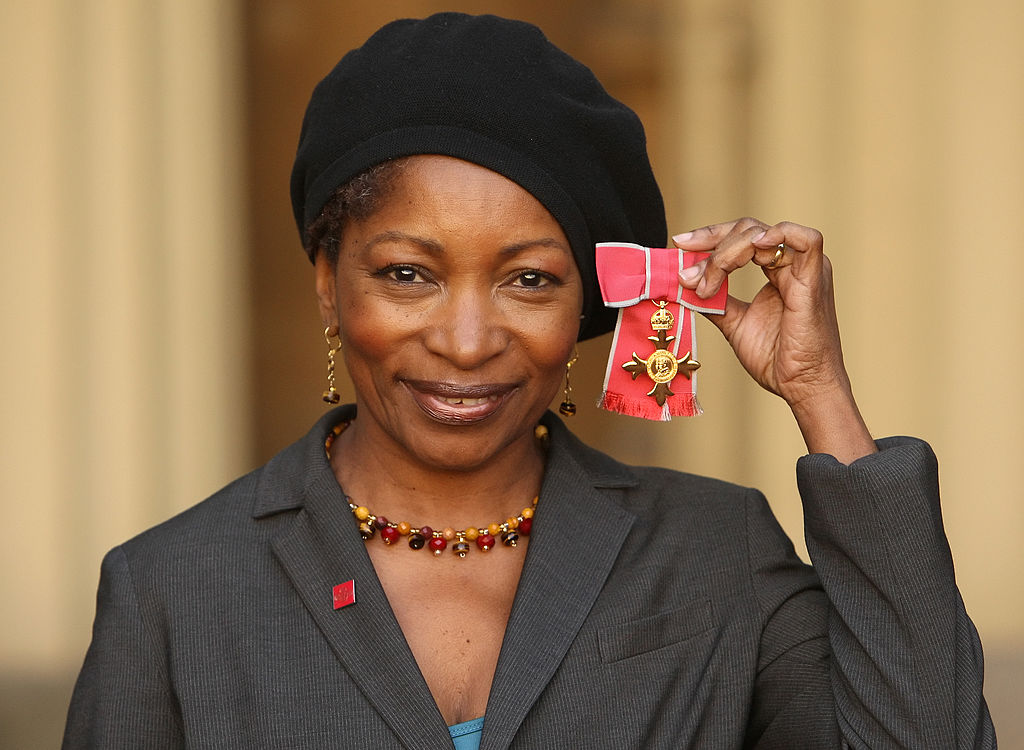
In many ways Britain also adopted Bonnie. She became a regular face on television, appearing regularly on the BBC’s Newsnight Review and Question Time. She was awarded the OBE, served two terms as a trustee of the British Museum, has her portrait in the National Portrait Gallery, was Chancellor of Kingston University and a Fellow of the Royal Society of Arts, amongst other high-profile positions.
Although she held prestigious positions and awards, Bonnie was never an establishment figure. She was never afraid to stick to her principles and was a passionate advocate against racism and misogyny. Never more so than when, after great deliberation, she joined the panel of Question Time with Nick Griffin, the leader of the BNP. She dealt with him gracefully and turned the experience into a chamber opera Yes, which was performed in 2011 at the Linbury Studio Theatre at the Royal Opera House.
Although her experience as a black woman was central to her writing, theatre, critical analysis and her daily life, Bonnie was keen to point out the difference between the American and the British black experience. She saw Black America as having a more unified history of slavery and a mainly rural heritage, whereas Black Britain was more urban with many different cultural heritages. However, she always emphasised that all were united by the prejudice they endured and the experience of being categorised as Black, the moment they opened their door.
Bonnie had amazing energy. As well as television and all her other commitments, her creative output was immense, although she told me that she wished she had produced more. She wrote two musicals – Solid and Marilyn and Ella, which she wrote after finding out that Marilyn Monroe had helped Ella Fitzgerald to perform in venues like the Mocambo nightclub where segregation prevented Fitzgerald from appearing. She also wrote the novel Entropy, a book Obama Music, a biography of Langston Hughes and her autobiography A Parallel Life, that is a must read. She also wrote the screenplay for the film, White Men Are Cracking Up.
When Trump was elected, politics became even more important for Bonnie. This was around the time I first met her. We were privileged that Bonnie joined us at Byline Times as a regular writer. She was keen to warn our readers of the dangers of Trumpocracy in Britain, as well as helping them understand how America had succumbed to the Far Right. With Trump’s second term, Bonnie felt that America as she knew it was doomed. She wrote to me:
“I think an era of American history has come to an end. America was always a fragile project – and now the project is over, and a new one has to emerge.” She went on to say, “I’ve been politically engaged since I was a teen – and that is for a long time – and I’m telling you the Republic is on the brink”.
Bonnie felt that only through understanding culture and myths that we could understand what has happened to America:
“Trump is the perfect avatar and was always in the wings…or someone like him because this is baked into the US…The approach to the US now is not to ask why stuff isn’t working etc. It is to look at its origin myths and roots and then you can see where it is; and where it is going, American papers can’t do this.”
She said that was why films were so important. Especially the ones that saw what the “so-called American experiment was and is”. That is why she called filmmakers “canaries in the coal mine” because they know first.
She expanded on this when she and our Byline Times editor in chief Hardeep Matharu produced a podcast series Americana which looked at cultural moments in America’s past and their contemporary significance. All we had to do was hand Bonnie the microphone and her cultural and political commentary flowed effortlessly and lyrically.
Bonnie was keen to work with us at Byline Times on one final project. About a month ago, she shared with us the sad news that she had a terminal illness, but she believed she would have another year to complete one final project. It was born out of an incident that she told us about several years ago and related in a BBC podcast, when in her youth she shared a taxicab with James Baldwin. As she wrote to me: “Jimmy asked me to take a taxi ride with him to O’Hare Airport, where he opened up as to how he worked for my generation forever, but we called him a betrayer, and a faggot interested in white men. He died with this in his ears. Somehow this has haunted me for over fifty years.”
Bonnie wanted this book to look not just at how her generation had let James Baldwin down, but even more to be a letter to younger generations about Boomers and the world they were handing down to future generations. Unfortunately, it will never be written as in the end Bonnie tragically ran out of time.
Fortunately for us, Bonnie has left a great body of work behind, including podcasts, radio and television, in which you can hear her immense passion, energy, insight, humour and humanity all wrapped up in those jazz-like riffs that transport you back to the 1960s Chicago blues club where she waitressed as a student.
I will find it difficult to go back the Union Club without Bonnie. It will seem empty without her gleeful enthusiasm as we discuss her next project with her champagne glass in hand. Soho has lost one of its most brilliant residents and all of us have lost a unique voice and spirit.
ENJOYING THIS ARTICLE? HELP US TO PRODUCE MORE
Receive the monthly Byline Times newspaper and help to support fearless, independent journalism that breaks stories, shapes the agenda and holds power to account.
We’re not funded by a billionaire oligarch or an offshore hedge-fund. We rely on our readers to fund our journalism. If you like what we do, please subscribe.