
 Subscriptions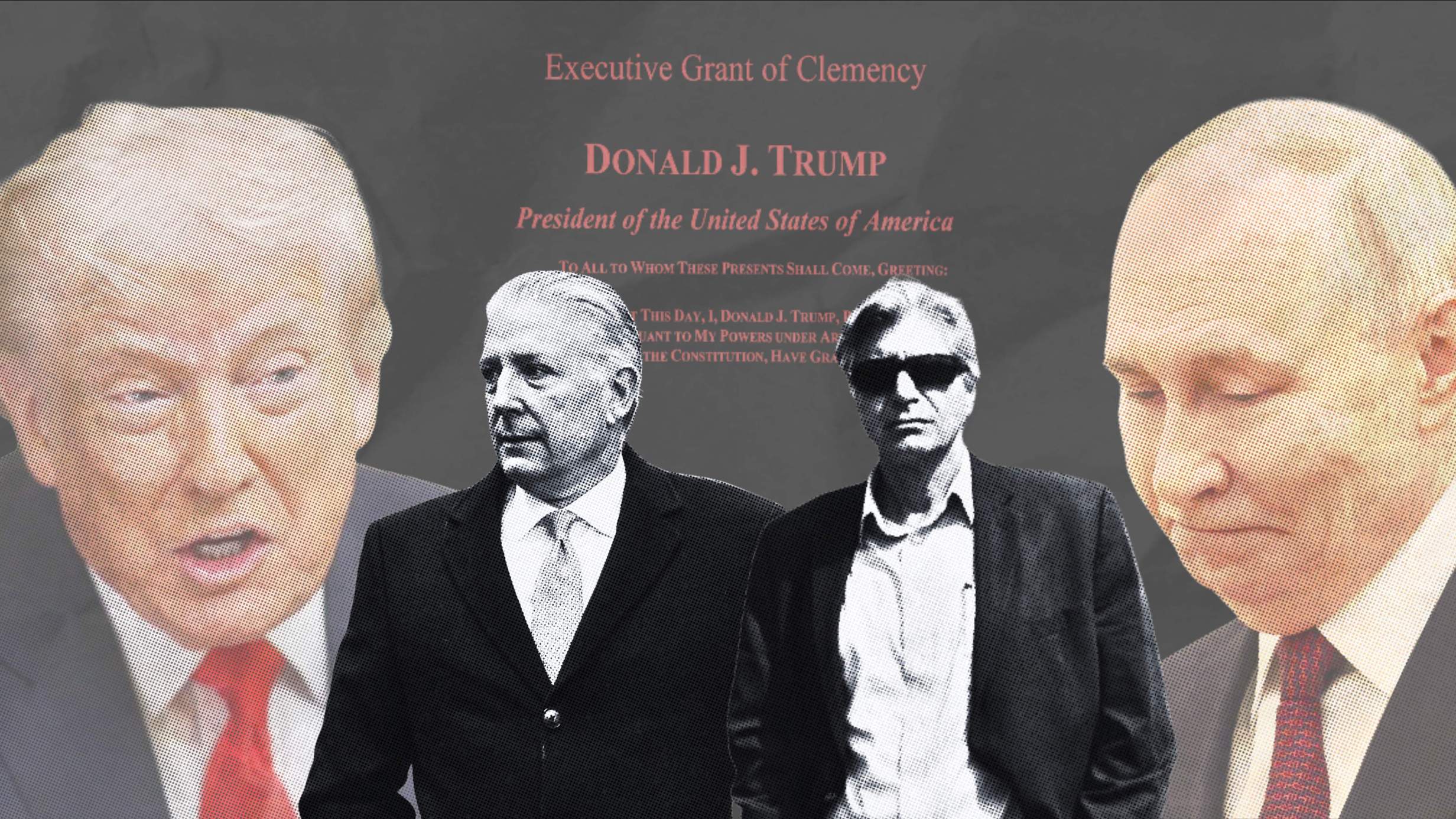

Read our Monthly Magazine
And support our mission to provide fearless stories about and outside the media system
On 15 January 2026, President Donald Trump pardoned a former FBI counterintelligence agent who had refused to testify about his work for Oleg Deripaska and Dmitry Rybolovlev – two Russian oligarchs with direct ties to Vladimir Putin’s inner circle. The pardon came six months after the daughter of the former agent’s co-defendant, Julio Herrera Velutini, donated $3.5 million to Trump-aligned super PACs. The decision permanently sealed the record of services US intelligence officials secretly provided for sanctioned Russian networks.
Former FBI agent Mark T. Rossini’s business partner – Charles McGonigal, the agency’s former counterintelligence chief in New York – is currently serving more than six years in federal prison for taking Deripaska’s money.
Trump’s pardon extinguished the possibility that Rossini’s services to the Putin-linked oligarchs might come to light, including who directed that work, and whether it connected to Rossini’s involvement in a subsequent bribery scheme involving his co-defendants.
Trump’s pardoning of Rossini arrived alongside clemency for the latter: former Puerto Rico Governor Wanda Vázquez Garced, who had endorsed Trump in 2020, and Julio Herrera Velutini, a Venezuelan-Italian billionaire banker.
Their defence team included both Trump’s personal attorney from the Mar-a-Lago documents case and a former senior CIA lawyer who had advised on destroying videotapes documenting the agency’s torture of detainees.
The Oligarch Connection
Oleg Deripaska built his aluminium fortune with Kremlin backing and has been described by US Treasury officials as operating on Vladimir Putin’s behalf. In 2018, the US Government sanctioned him for his role in Russia’s interference operations.
Dmitry Rybolovlev made his fortune from shares in the Russian fertiliser giant Uralkali. He is reportedly closely linked to Yuri Trutnev, Putin’s special representative in the Vladivostok region, and in 2018 was listed by the US Treasury for “closeness to the Russian regime”.
Ten years earlier, Rybolovlev purchased Trump’s Palm Beach mansion for $95 million in 2008 – nearly twice what Trump had paid – in what became one of the most scrutinised real estate transactions of Trump’s career.
Rossini’s work for these oligarchs came through an obscure firm called “USG Security Limited”, run by British-Israeli security consultant Walter Soriano.
In June 2019, USG Security was subpoenaed by the Senate Intelligence Committee as part of its investigation into Russian interference in the 2016 election.
Russian court filings later revealed that USG Security had signed a contract to provide security services for the 2014 Sochi Winter Olympics, including direct control at Sochi International Airport during what was Putin’s showcase event.
‘Trump Has Already Rigged the 2028 Presidential Election’: US Defence Insider
Regardless of how people vote, the chances of a Democrat Government coming to power in 2029 is now virtually nil, argues Brynn Tannehill
In 2023, journalists at Forensic News hoped to learn about Rossini’s work by seeking Rossini’s testimony in a defamation case. In response, he invoked the Fifth Amendment and refused to answer specific questions about what his firm had performed for both oligarchs.
Magistrate Judge Robert W. Lehrburger upheld the invocation, finding Rossini’s fear of prosecution reasonable given that the Justice Department was actively pursuing people who had aided Deripaska. Rossini, the judge wrote, has demonstrated reasonable ground to believe that answering the questions may fuel further criminal prosecution against him.
The Network
Rossini is part of a network of former US intelligence and law enforcement officials who cashed in their expertise for clients whose interests conflict with American policy.
Albanian corporate records show that the two FBI partners, Rossini and McGonigal, each owned 25% of a company called “Lawoffice & Investigation”.
The third partner in their Albanian venture was Agron Neza, a former Albanian intelligence officer who had handed McGonigal $225,000 in several cash instalments – some in a parked car, some at Neza’s New Jersey home – while McGonigal still ran FBI counterintelligence in New York. Neza later became an FBI informant against his former partner and has not been charged.
McGonigal pleaded guilty to accepting payments from Deripaska and to concealing the $225,000 payments via Neza, while still running FBI counterintelligence.

The Billionaire’s ‘Laundromat’
In August 2022, a federal grand jury indicted Vázquez, Herrera, and Rossini on conspiracy and bribery charges that carried a 20-year maximum sentence.
Prosecutors alleged that billionaire banker Julio Herrera Velutini wanted to decapitate Puerto Rico’s banking regulator because the agency was scrutinising his bank’s anti-money-laundering compliance. Herrera allegedly used Rossini as the intermediary to buy the Puerto Rico Governor Wanda Vázquez Garced’s cooperation with campaign cash.
The regulatory fear was well-founded. Investigators later hit Herrera’s bank, Bancrédito, with a $15 million penalty for failing to report hundreds of millions in suspicious transactions linked to a Venezuelan Ponzi scheme, international drug trafficking and a global cryptocurrency scam.
However, what began as a public corruption case in Puerto Rico took a bizarre turn in September 2024 when the defence moved to compel the Government to produce classified records regarding their employers and financial networks. This, however, invoked the Classified Information Procedures Act (CIPA).
Usually reserved for espionage and counterintelligence cases, CIPA allows the US Government to protect state secrets during a trial. The defence move may have been “graymail” – a legal manoeuvre where the defence threatens to expose sensitive national security secrets unless the Government drops the charges.
The tactic seemingly worked. Instead of producing the classified records, by June 2025 the US Department of Justice’s resolve crumbled. They bypassed the grand jury to file a single misdemeanour ‘slap on the wrist’ plea. The trial was successfully neutralised before the pardons even arrived and Rossini’s secrets stayed secret.
Trump’s Violent Assault on Minnesota Is an Operation in ‘Reflexive Control’
The President is using Soviet-style redirection to wage an information war across America, argues Grant Stern
The Cleaners: Erasing the Paper Trail
As the case veered into the realm of classified secrets, Herrera swapped local counsel for a high-powered team of ‘cleaners’ – lawyers with connection to Trump’s inne