
 Subscriptions
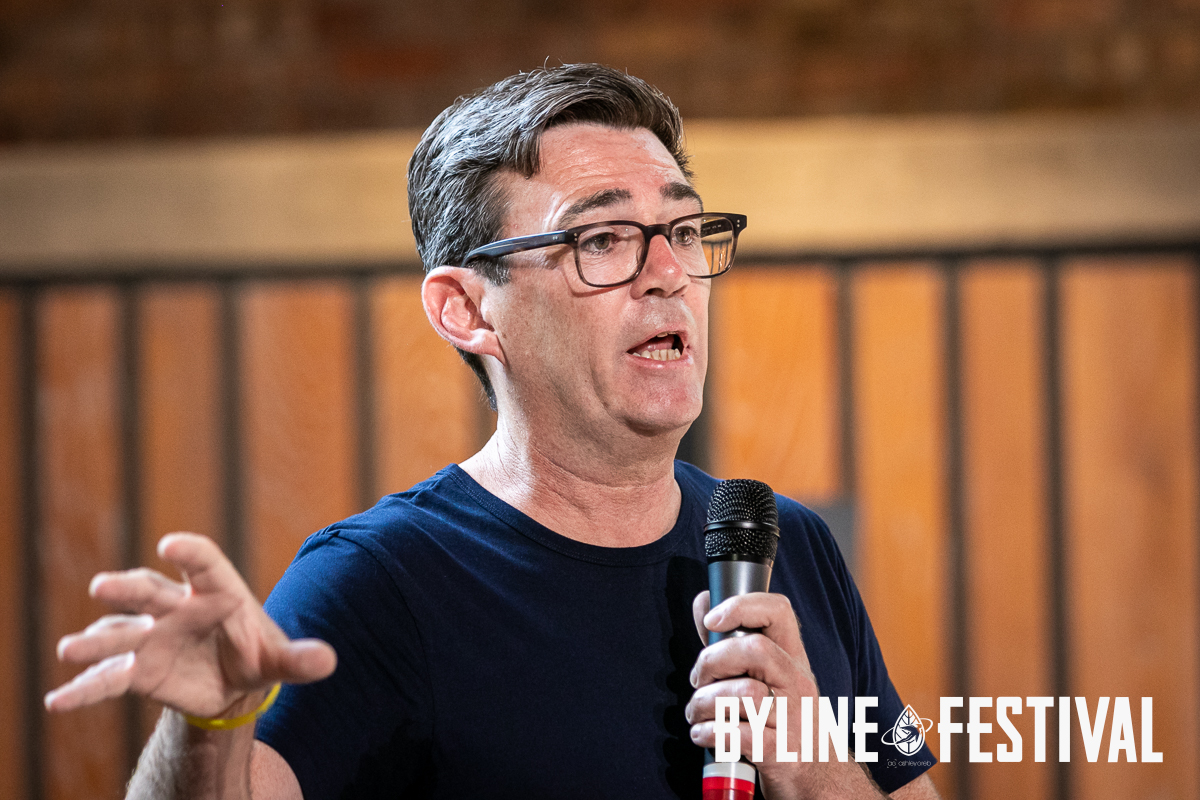
Andy Burnham is Labour’s Greater Manchester Mayor. He was the Labour MP for Leigh from 2001 to 2017, and served as Chief Secretary to the Treasury, Culture Secretary, and Health Secretary in Gordon Brown’s Cabinet. He sat down for an interview at the 2025 Byline Festival with Hardeep Matharu, Editor-in-Chief of Byline Times
HM: You have had an interesting political journey. You are currently Labour’s Greater Manchester Mayor. You were a Labour MP and Cabinet minister for many years. You grew up in the north-west. What made you want to become an MP and get into politics in the first place and why did you then leave Westminster?
AB: I came into Parliament at 31 years old in 2001 thinking that I’d be able to right some of the wrongs I’d seen growing up in the north-west: the north-south divide, the sense sometimes that people were treated as second-class. That was a part of me and I wanted to do something about it. In the 16 years I spent in Parliament, I think it took me about halfway through to work out that Parliament wasn’t going to be the answer to those things. In fact, it was the problem. It created those injustices. That was a massive moment of realisation for me.
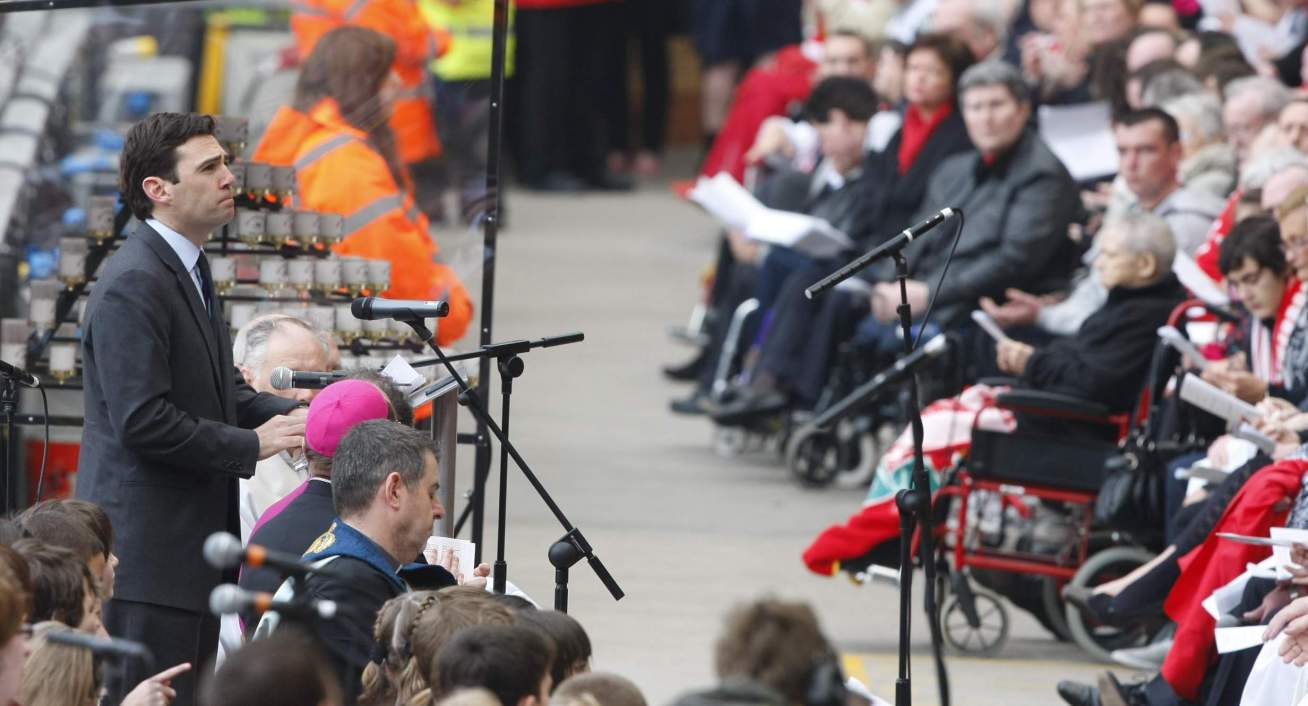
The big turning point was when I was invited to speak at the 20th anniversary of the Hillsborough disaster as Culture Secretary. When I really thought deeply about it, what I realised was that the entire British state had been ignoring an English city crying out for justice for 20 years. It wasn’t just by accident. It was deliberate. Having been at the other semi-final match on that day, and having had many friends who were at Hillsborough, I was thrown into crisis by that invitation because I was in a Government that hadn’t done anything for the Liverpool supporters and the city of Liverpool. It was a classic case of the establishment not wanting it to be opened up. The Labour Government had a commitment to reopen Hillsborough, but quickly another Whitehall stitch-up took place, and it didn’t. Hence I knew what I was walking into that day.
But when I went to Anfield, in many ways, I was taking my first steps out of the Westminster system. Because the only way I could reconcile the kind of position I was in was actually not to do the Westminster thing. If you’re going to be true to yourself, you have to walk outside of it, and that’s what I did. I walked outside of the collective responsibility in deciding to try and reopen [the issue of justice for] Hillsborough and use what political power I had at the time to do that.
From the outside looking in, people will remember you as having a high-flying career in Westminster, which you seemed to be flourishing in as a minister. But behind the scenes you are saying there was a lot that was having to be accommodated to even be a politician operating in the Westminster system and achieving success in it. Did you feel you had become part of the ‘establishment’?
I’ve always in my life had a degree of imposter syndrome. I went to Cambridge University but I couldn’t relate Cambridge to where I had grown up. You would hear these people holding forth and it took me a year to work out they were talking complete rubbish, but it looks so convincing. I had it too when I went into Parliament. And I had it a bit again when I was in government.
I was always, in a sense, having to prove myself and become part of the ‘in crowd’. But the experience of being in Westminster, as the years rolled, meant I knew I wasn’t fully in the ‘in crowd’, particularly when that invite came to the 20th anniversary of the Hillsborough disaster – it kind of made me choose. Was I going to be true to myself and what I knew to be the facts about Hillsborough, or was I going to play the Westminster game?
The interesting thing about the British political system is that it makes you choose. It doesn’t let you be both yourself and operating at a high level within the system.
In which specific ways does the Westminster system mean that politicians can’t be themselves and what reforms do you think are required?
The phrase people use is ‘they’re all the same’ [about politicians] but actually they’re not. That’s the problem, in my view, because most MPs, whoever they represent, go in with a pretty good heart and a pretty good intent about wanting to do things. There’s 10% who don’t, who are very career-minded, but the majority are decent people. The reason they end up looking like they are ‘all the same’ is because of what the system does.
The whip system, in my view, is corrosive of people’s independence and, indeed, of their authenticity. The longer you’re in Parliament, the more you are at risk of it making a fraud out of you, because it makes you vote in certain ways, say certain things, take