 Subscriptions


Read Our Monthly Magazine
And support our mission to provide fearless stories about and outside the media system
Killing People
In the first wave of the Coronavirus pandemic in 2020, I interviewed an NHS nurse who told me that “people are being taken into hospitals and murdered”.
Those in her profession were running “death camps” that were “no different” to those of “the Third Reich”, Kate Shemirani said. “When I liken this to Auschwitz and the cattle trucks, you tell me the difference? I am science-led and I am law-led… I call it genocide”.
At the time, some criticised Byline TV for giving Shemirani ‘a platform’ for her conspiracy theories. When challenged on her outlandish claims, she called me a “special snowflake”. Admittedly, I found it difficult to know how to deal with such an interaction as a journalist. One viewer commented that I looked almost “frozen” while listening to her impenetrable monologues. The interview stayed with me for days afterwards. It was disturbing.
Byline TV decided to speak to Shemirani because, at the height of a public health emergency, her fringe views – and others like them – were spreading on social media. In the uncertainty and upset of lockdowns and socially-distanced deaths, people were in search of stabilisers. And Shemirani was already enjoying a platform that she used to speak directly to those questioning the chaos.
Legitimising her claims was, clearly, not the aim, but I wanted to hear what she had to say. Without bringing such conspiracist mindsets into wider view, and attempting to counter them, often to no avail, it is difficult to identify and understand what exactly is being claimed in the crevices of conspiracist social media communities – and why people are drawn towards them in the first place.
Often, the stock response to conspiracy mindsets like Kate Shermirani’s is ‘ignore them and they’ll go away’. But, if the past few years have taught us anything, these conspiracist social media communities have flourished regardless.
Having declared the pandemic to be a hoax and vaccines part of a plan to kill people, Shemirani was struck off as a nurse in 2021. Now branding herself as “the natural nurse”, she sells membership to her alternative health business.
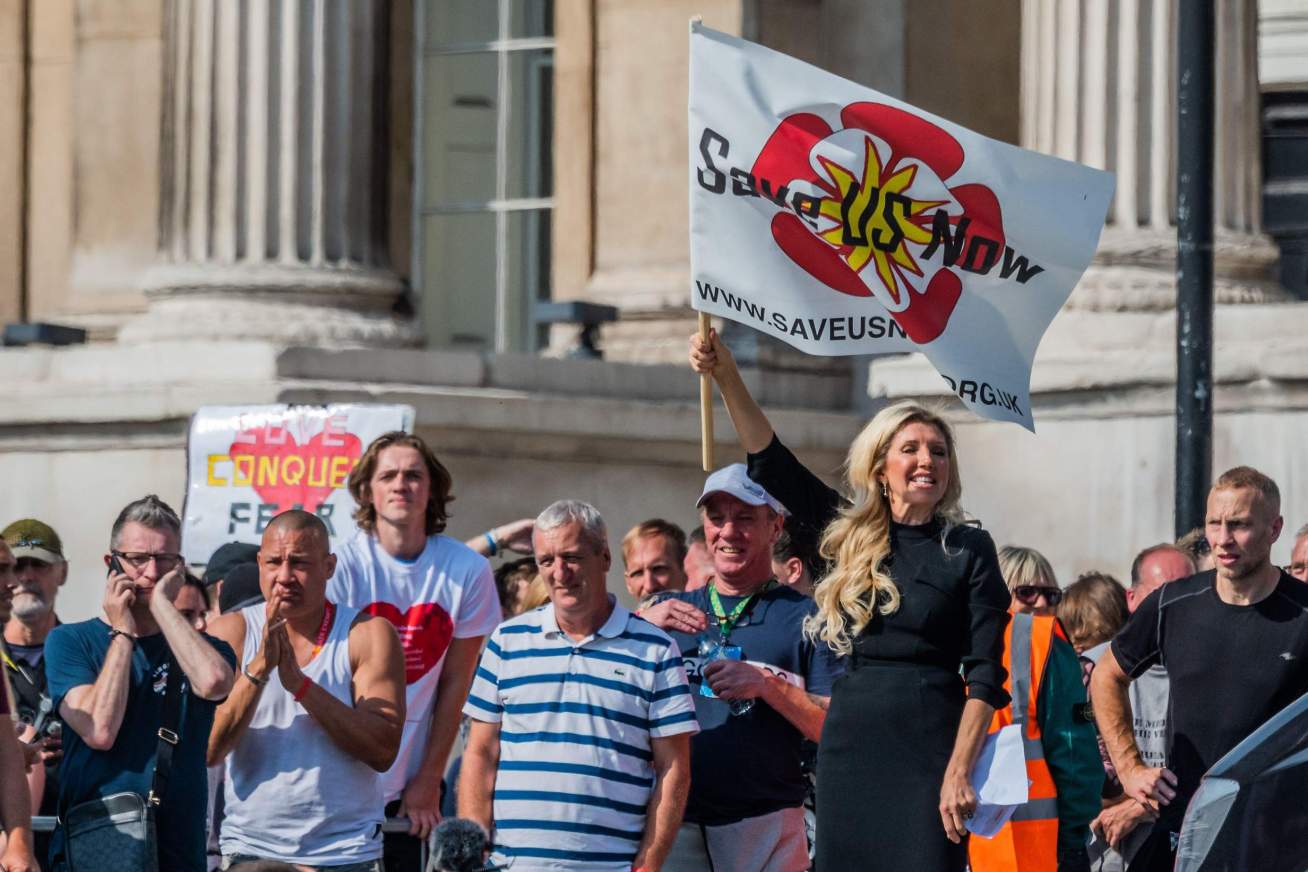
For a time, her social media accounts were suspended over the promotion of misinformation. When Elon Musk took over the then Twitter, she was reinstated on what became X, as well as on Facebook.
“I see her as a public health issue rather than a close family relative” is how her son Sebastian Shemirani described his estranged relationship with his mother a year later when I interviewed him for Byline TV.
Arguing with her, according to Sebastian, simply had the effect of confirming – in her mind – that she was ‘right’. It was not only unhelpful to engage with her thinking, he said, but harmful: when presented with challenging facts, she would double-down.
In all the discussions of our ‘post-truth’ age and social media platforms pumping out disinformation and misinformation, it is easy to overlook the cost of it all amid the personalities of those promoting these ideas. But there is always a cost: often, bit by bit, to our shared sense of any sort of collective reality; and, sometimes, suddenly and fatally to those who pay the ultimate price.
In June, a BBC Panorama investigation revealed that 23-year-old Cambridge University graduate Paloma Shemirani had died after refusing treatment for cancer.
Told by doctors that she had a high chance of survival with chemotherapy, she was dead seven months later. She was the daughter of Kate Shemirani.
Her older brother Sebastian, and her twin brother Gabriel Shemirani, blame their mother’s anti-medicine conspiracy theories for their sister’s death last year.
Instead of the medical treatment recommended, Paloma tried ‘Gerson therapy’ – a strict plant-based diet, supplements, juices, and coffee enemas – which some claim, without medical evidence, can treat cancer. Her brothers say they believe Paloma refused medical treatment after being influenced by their mother’s beliefs, which they say Kate Shemirani used to coercively control her children’s lives and relationship with her.
Kate Shemirani told the BBC that she has evidence that “Paloma died as a result of medical interventions given without confirmed diagnosis or lawful consent”. She claims the NHS has engaged in a cover-up and that this is “one big massive manslaughter case”.
“Medicine is a lie and what we once believed to be healthcare is now a homicide service”, she wrote on X.

Populist Simplicity in a Hyper-Complex World: Will Trump Overplay His Hand?
Hardeep Matharu dissects what the now infamous Oval Office meeting with Volodymyr Zelensky revealed about the American President’s approach – and speaks to political scientist Brian Klaas about why his ‘alternative realities’ don’t stack up against real-world complexities
The Politics of Projection
The death of Paloma Shemirani would seem to suggest that ‘truth’ and reality are starkly different things in today’s world.
While we all now have our own ‘truths’ – highly-personalised and curated, just as the social media platforms that promote such a framework for making sense of the world encourage – there is a shared reality that plays out regardless of how we might want to individually spin it.
But beyond talk of fact-checking, cults, and social media regulation, one question is seldom asked: what is it about the age in which we live that makes evidence-free beliefs attractive to increasing numbers of people?
Beliefs ungrounded in evidence are not new – one only has to look at organised religion to understand the role such ideas can play in people’s lives. And as religion has declined in western societies, other belief systems have taken root. Even the most sceptical and atheistic of us have a narrative and a value system we believe in. A way to understand a world that is rapidly shifting around us. To make sense of who we are. To find some security about where we belong. Such beliefs, by their very nature, are often not pri