
 Subscriptions

Read our Monthly Magazine
And support our mission to provide fearless stories about and outside the media system
Eleven police officers and a police dog were injured in Southampton when rioters took to the streets in Henry Nowak’s name, days after his killer was convicted of murder. On Tuesday morning, hours after a knife attack in north Belfast in which a Sudanese man was arrested on suspicion of attempted murder, the far-right activist Tommy Robinson (real name Stephen Yaxley-Lennon) demanded immediate protests. Calls for similar demonstrations are now spreading across social media in Northern Ireland.
Here’s what’s being ignored. From the 1999 Macpherson Inquiry to the 2023 Casey Review, a quarter-century of official findings record racial bias in British policing running against black people – the reverse of the “two-tier” bias far-right rioters invoke.
Meanwhile, the institutions now accused of failing white Britain are presiding over the lowest homicide rate in England and Wales since 1977.
Within hours of the conviction, the case stopped being about Henry Nowak. The X owner Elon Musk posted about it more than 100 times and offered to fund a private prosecution of Hampshire Constabulary; the US Vice-President JD Vance said Nowak would still be alive if Europe had resisted “the mass invasion of migrants”; the Reform UK leader Nigel Farage demanded “pure cold rage”, claiming police are instructed in writing to treat ethnic groups differently.
What ‘Two-Tier Policing’ Actually Means
Around the 1981 Brixton uprising, “two-tier policing” described the over-policing of black communities – bias against them. In its new far-right usage, it means police going soft on minorities and hard on white people. After the riots that followed the 2024 Southport murders, the cross-party Home Affairs Committee investigated the claim, found no evidence for it and branded it “disgraceful”.
In the year to March 2025, Home Office figures show black people between four and five times more likely to be stopped and searched than white people; in 2018/19 the gap stood at 8.3 times.
Stop and search is most often used to look for drugs. Yet when Her Majesty’s Inspectorate of Constabulary analysed more than 8,500 stop and search records, it found the drug “find rate” was 33% where the person searched was white and 26% where the person was black.
In some of London’s wealthiest wards, a King’s College London analysis of 152,000 Metropolitan Police records found black residents up to 48 times more likely to be searched; across London, two-thirds of searches end in no further action.
The 2023 Casey Review – commissioned by the Met itself after the murder of Sarah Everard by a serving officer – analysed the Met’s own data and found that black people in London aged 11 to 61 are more than three times more likely to be handcuffed than white people of the same age, 4.5 times more likely to have a baton used against them, and nearly four times as likely to have a Taser fired at them. Baroness Louise Casey concluded the Metropolitan Police was institutionally racist.
Her review found black officers 81% more likely to face disciplinary action than white colleagues, and new ethnic minority recruits more than twice as likely to be served a Regulation 13 notice – deemed unsuitable for policing – as their white counterparts. Nationally, black people are arrested at more than double the white rate.
A study for the Sentencing Council, controlled for 42 separate sentencing factors, still found black defendants 40% more likely, and Asian and other-minority defendants 50% more likely, to be jailed than comparable white defendants.
The 2017 Lammy Review found that for every 100 white men jailed via the Crown Court, 112 black men were jailed – 141 black men and 227 black women for drug offences. Black people are about 4% of the population and 12% of the prison population. As far back as 1999, the Macpherson Inquiry found the same “racist stereotyping” in stop and search.
But the far-right has a standard response to these figures, that has become increasingly normalised now in political and public discourse. The reason police are targeting minorities more, they say, is because minorities tend to be criminals more. The fault is with these ethnic groups, not the police.
ENJOYING THIS ARTICLE? HELP US TO PRODUCE MORE
Receive the monthly Byline Times newspaper and help to support fearless, independent journalism that breaks stories, shapes the agenda and holds power to account.
We’re not funded by a billionaire oligarch or an offshore hedge-fund. We rely on our readers to fund our journalism. If you like what we do, please subscribe.
Murder
The far-right will point out that, for instance, that in London, black people are around 13.5% of the population but, on Met figures, 43.6% of those charged with murder ; nationally, about 20% of those convicted of homicide are black, five times the population share.
This must imply, the far-right implores, that black people are inherently violent. So much so that that they even kill their own.
This idea has taken particular force in the United States, where under the Trump administration in particular the narrative that black and brown communities represent danger, disorder, and lawlessness has underpinned a new, militarised policing strategy.
But the claim does not withstand empirical scrutiny. The 2023 US National Academies of Sciences review found that the racial gap in violence tracks the concentration of poverty rather than the concentration of black people: comparing black and white Americans in equally deprived neighbourhoods, the gap in property crime shrinks to nearly nothing and much of the violence gap closes too. The report concluded that race is “a marker for the accumulation of social and material adversities” – a proxy for deprivation, which is what drives the violence.
The National Academies study acknowledges that a century ago Italian and Irish immigrants were heavily involved in crime, yet escaped the label of inherent criminality and were given routes out of poverty. The same has not happened for black communities in America.
In Britain, the data similarly shows that the racial poverty and economic discrimination gap explains the racialised patterns of crime. Around 40% of people in black African households live in poverty, and roughly half their children, against about a fifth of white children; black unemployment has long run at roughly double the white rate; and the state’s own statisticians trace the pathway from childhood poverty to unemployment and, for men, prison.
This is the long shadow of the post-imperial settlement that steered black Britons into the lowest-paid, most heavily policed corners of the country.
Don’t miss a story
Knife Crime
The far-right claim that knife crime is a black problem is another statistical artefact. In London, two-thirds of under-25 knife offenders are from minority backgrounds.
But across England and Wales the picture reverses: only 38% of under-25 knife-possession offenders are from minority backgrounds, and 27% across all ages. Nationally, the typical knife offender is white at approximately 68% of individuals cautioned or convicted for knife-enabled offences.
The London disparity tracks poverty and density rather than race. Knife crime in England and Wales is heavily concentrated in the most deprived urban areas – the same areas where black communities were structurally settled in the post-war decades.
The clearest proof that race is not the central determinant of the crime can be found in Glasgow. In 2004/05 Scotland recorded 137 homicides, a rate that peaked at 26.3 per million; Glasgow alone, double the national rate, was Europe’s “homicide capital”. The profile was almost identical to London’s – young men, public places, knives, the 16–24 accused rate at 111 per million – in a population that was about 96% white.
Then Scotland set up its Violence Reduction Unit in 2005 and treated the killing as a public health problem of deprivation rather than a moral or racial defect. Homicides more than halved, to 45 in 2024/25, the lowest since 1976; the rate fell about 60%, the steepest fall coming exactly where the crisis had been worst, as the 16–24 accused rate collapsed from 111 to 25 per million. Western Europe’s deadliest knife epidemic, and its reversal, played out in a population that was almost entirely white – driven by poverty, resolved by opportunity.
The figures are also circular. The Government’s own knife-crime evidence note attributes the over-representation of black children to “much higher use of stop and search for black children” and deprivation, while the Home Office notes that recorded weapon-possession offences are “influenced by police activity, such as use of stop and search”. The figure cited to justify searching black youth is, in part, a record of having searched them.
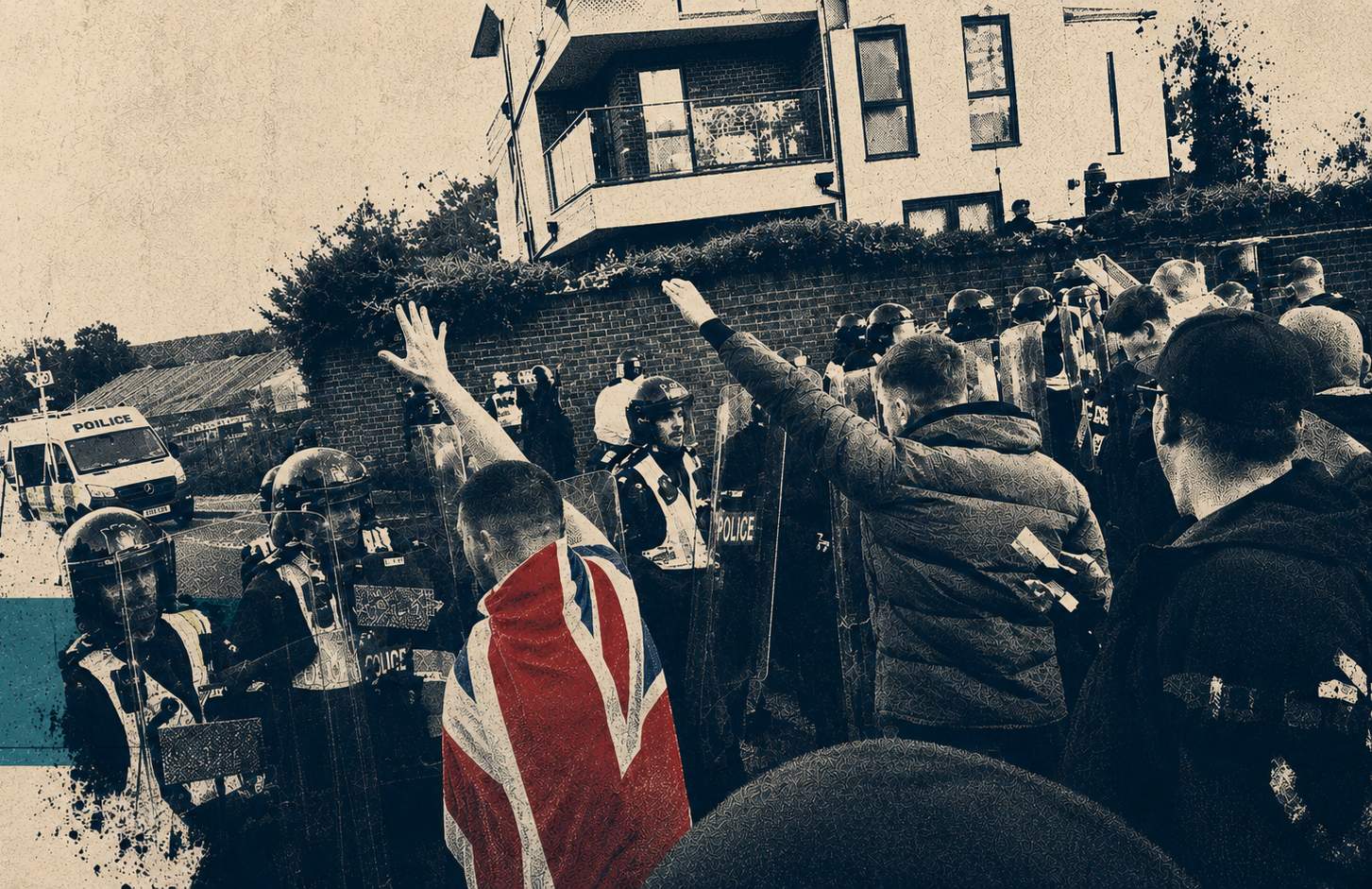
The Neo-Nazi and Far-Right Coalition that Converged on Southampton Over Henry Nowak’s Murder
There were Nazi salutes and ‘White Power’ chants on the streets of Southampton, after the Reform UK leader called for “pure cold rage” in response to Nowak’s death
Robbery and Theft
Robbery – theft that involves force or the threat of force – shows the largest racial disparity in the figures: around 49% of London robbery suspects and 39% of prosecutions nationally are black.
Yet Trust for London data shows robbery is twice as likely in the capital’s most income-deprived areas as in the least deprived, and black communities are disproportionately concentrated in those areas – a legacy of the same post-imperial settlement. Robbery, particularly phone theft, is an opportunity-structure crime concentrated in dense, low-income urban transport corridors.
The over-representation is a poverty and geography pattern in which race and place have been structurally entangled for decades.
Across theft as a whole, the pattern reverses: theft across England and Wales is the single largest conviction category for white offenders, who account for 78% of all theft convictions. White people dominate burglary, shoplifting and vehicle crime by volume, while black people account for only 10% of theft convictions overall. Robbery’s over-representation is narrow, local and explicable by the same conditions.
Limits of the Disparity Data
Disparities are real but confined to a handful of serious, low-volume, urban crimes – murder, robbery, knife violence – that track age, poverty and geography. Stop and search, the policing tool deployed in their name, is mostly a drug operation: around 60% of searches are for drugs and 15% for weapons, and a weapon is found in about 3% of cases. The violence figures supply the justification; the drug search is what actually happens. Yet white people report higher cannabis use than black people, while black people are searched far more often, and drugs are found on them less often when they are.
The policing regime invokes knife murder to justify itself, spends its energy on a drug operation the violence figures never licensed, then counts the arrests as validation.
More than 70% of searches end in no further action. The police find something on two or three people in every 10, then cite those few as proof that the targeting works – and use them to justify the next 10 searches, and the 10 after that. Innocent black people are stopped and searched repeatedly, on the basis of statistics about their ethnic group, reinforcing a system that was discriminatory from the start.

How Neo-Nazis Posing as ‘Ordinary Parents’ Embedded Themselves in Anti-Immigrant Protests
A year long investigation by Katherine Denkinson exposes the Neo-Nazi and far-right extremists operating openly inside anti-immigration protests
Migration and Crime
Foreign nationals received 13% of convictions in England and Wales in 2024 and made up 12.4% of the prison population – roughly their share of the population. That is before age is taken into account. Migrants skew younger than the population as a whole, and younger people commit more crime wherever they were born.
Adjusted for age and sex, non-citizens are slightly less likely to be in prison than British nationals; for crimes like violence and robbery they are under-represented. Areas with the most Eastern European migration after 2004 saw property crime fall faster than elsewhere.
The Politics Behind the Panic
Knife killings are down 21% in the past year, and teenage knife homicides have almost halved – the steepest fall in violent death in living memory.
The story being told about Henry Nowak – white people persecuted, betrayed by a state that protects minorities – is the far-right ‘Great Replacement’ conspiracy theory (the claim that black and brown immigrants are ‘replacing’ native white people), now animating politicians from Washington to Westminster. The script predates Nowak; it was waiting for any victim who could be made to fit.
The far right requires only that outlets keep asking about ‘two-tier policing’ as though it were an open question, rather than one the Home Affairs Committee has already called “disgraceful” due to total lack of evidence. Each time the controversy is framed as a debate with two legitimate sides, the false premise wins.
The data proves that there is no such thing as anti-white “two-tier” policing in Britain. If “two-tier” policing is a thing, a quarter-century of research shows that black and brown communities are overwhelmingly on the receiving end of it.
The murder of Henry Nowak, and now the attempted murder in Belfast, are being seized on to mainstream long-standing far-right fantasies of invasion and anti-white persecution. Honouring him means what his family has asked for: independent, transparent accountability, a full reckoning with the failure that left him handcuffed and dying in a Southampton street, and a refusal to let that failure be conscripted into far-right extremism that wants Britain to fall into civil war.